.png)


.png)
YouTube integrations generate 40% of views after 30 days
YouTube creator integrations are paid sponsorship placements embedded directly within a creator’s video, where the creator features, endorses, or demonstrates a brand’s product or service. Unlike YouTube ads, these integrations are native to the content and remain live as part of the video indefinitely, generating views and clicks over time.
Most teams still evaluate YouTube creator integrations as traditional online ads: pay once, measure quickly, decide fast.
That instinct is understandable. And wrong.
True, YouTube integrations are paid once, typically as a flat fee. But unlike traditional ads, they generate views and clicks over time. Videos continue to surface through search, recommendations, playlists, and long-tail discovery for weeks, often months.
In fact, our recent analysis shows that on average, 40% of views and 30% of clicks occur more than 30 days after an integration goes live.
That means performance metrics like CPM and CPC depend heavily on how you recognize spend over time - specifically, the amortization window you choose. If your amortization window is too short, you make YouTube look expensive early, even when it’s compounding efficiently underneath.
The importance of amortizing spend the right way
Short windows dramatically overstate cost.
To illustrate this, consider a YouTube creator integration purchased on Agentio with a pronounced long-tail view curve. The video - and the embedded integration - went live on June 23, 2025.
The brand paid $2,500 for the integration at a $43 contracted CPM, meaning the pricing assumed an expected delivery of ~58,000 views in the first 30 days. This contracted CPM reflects the effective cost per 1,000 views agreed at signing, based on expected total view delivery in the first 30 days.
In the first 30 days:
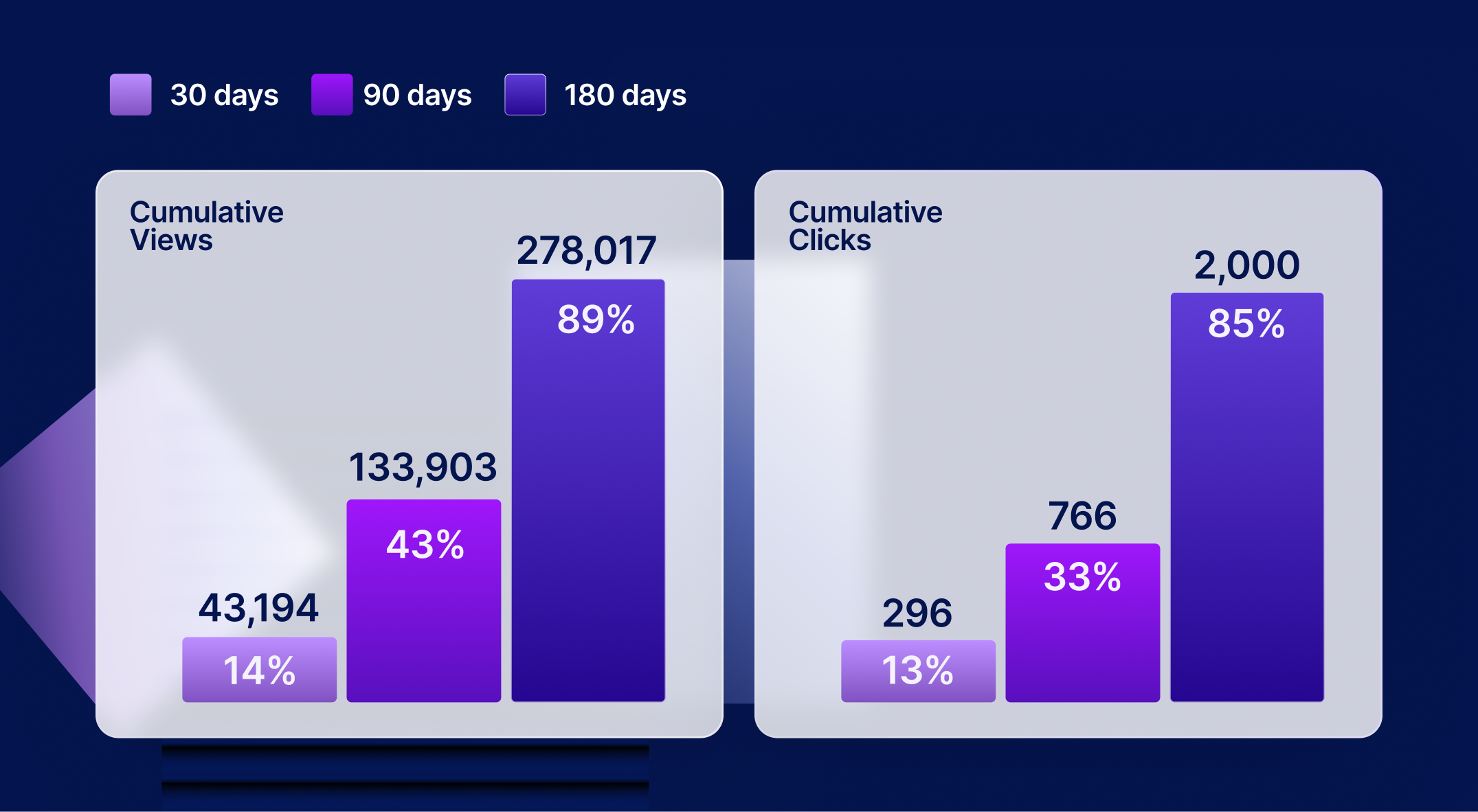
- The video generated 43,194 views, representing 14% of total views as of January 2026
- It drove 296 clicks, or 13% of total clicks
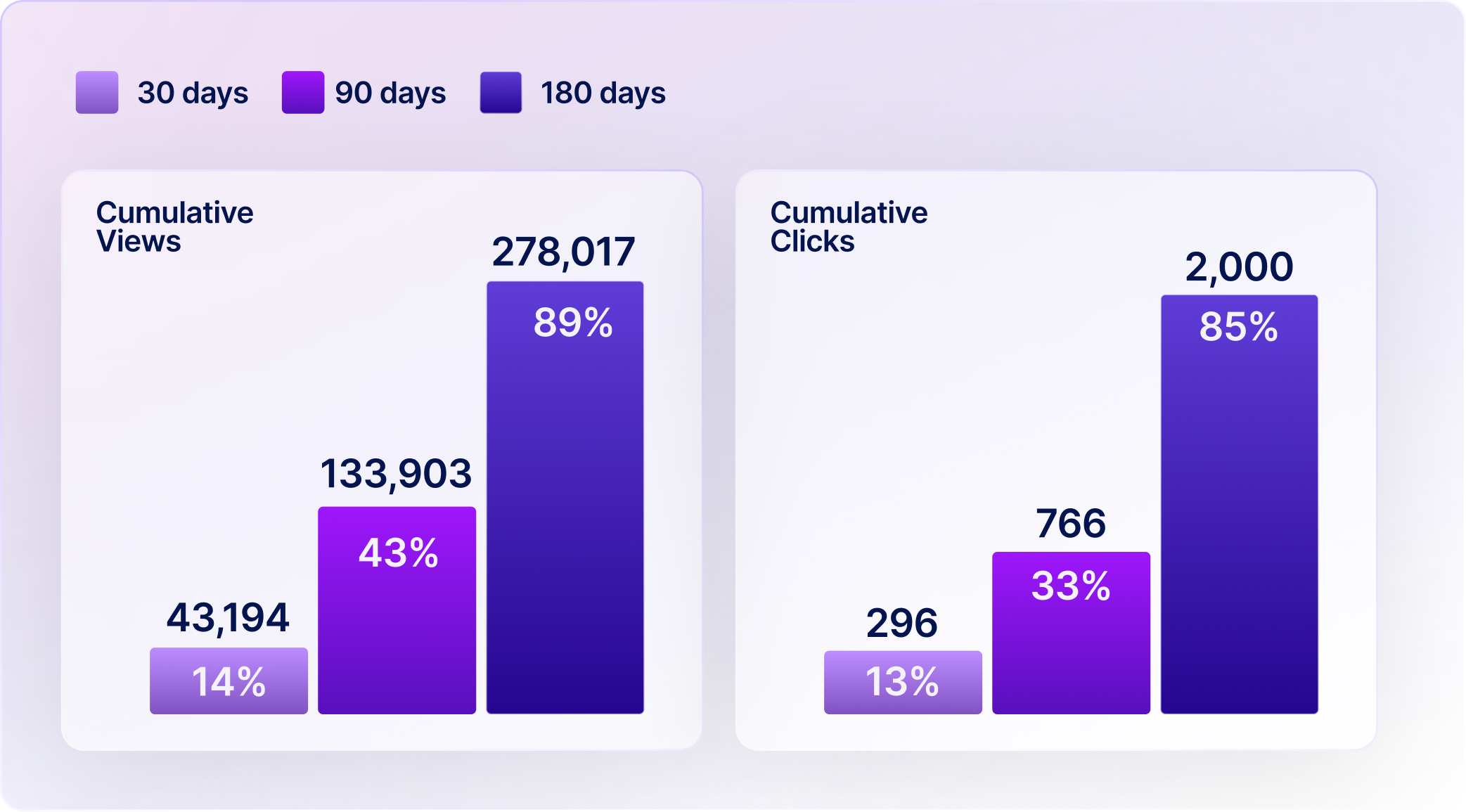
This is not an anomaly. It is exactly how YouTube behaves at scale, as shown across thousands of integrations.
As a result, the way you amortize spend fundamentally changes how performance appears, even when the underlying results are identical.
Same integration. Two different ways of amortizing spend
Before looking at performance metrics, it’s important to define the two amortization approaches:
- 30-day amortization
The full $2,500 is expensed over the first 30 days (~$83 per day) - 90-day amortization
The same $2,500 is spread evenly over 90 days (~$28 per day)
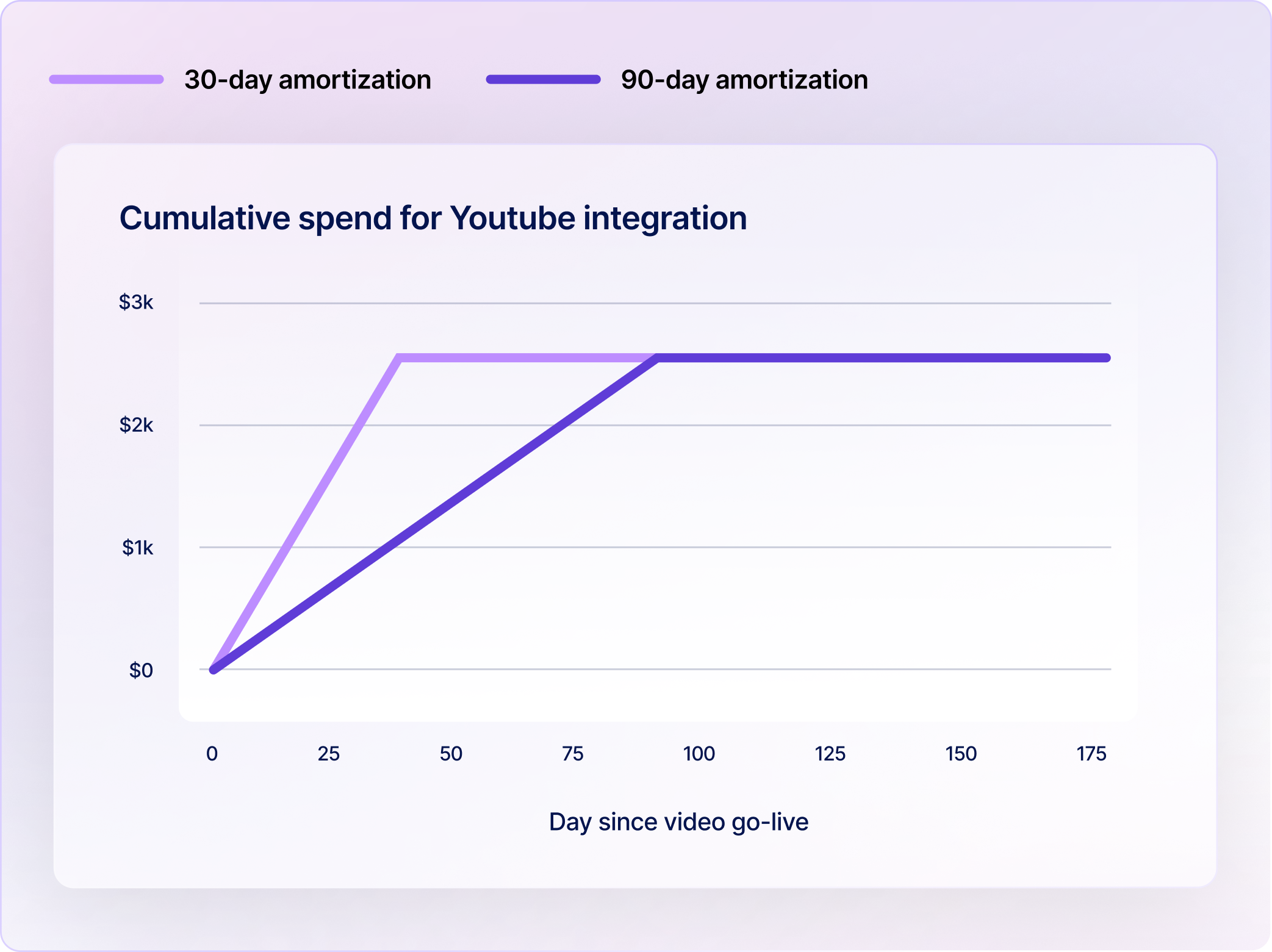
A 90-day amortization window makes performance reads more precise and stable over time, not slower
Now imagine two teams evaluating this exact integration on the same day: 30 days after go-live.
Both teams are reviewing the same metrics (CPM, CPC, volatility). Views and clicks for the video are identical. The only difference is how spend is amortized.
Here’s how that single integration looks under these two different amortization models when teams look at performance after 30 days:
.png)
Nothing about the integration changed.
Only the accounting did.
Under a 30-day amortization model, the dashboard shows a $58 CPM after 30 days - 35% higher than the contracted $43 CPM. The integration immediately looks overpriced. Finance raises questions. The channel gets scrutinized.
At this point, many teams freeze spend, cut future tests, or shift budget to “faster” platforms.
Now look at the same integration on the same day, evaluated with a 90-day amortization window.
The CPM is $19. The integration that looked “expensive” is now 55% cheaper than the contracted CPM - and more cost-effective than almost any paid channel.
.png)
Beyond headline CPM differences, volatility is the real issue.
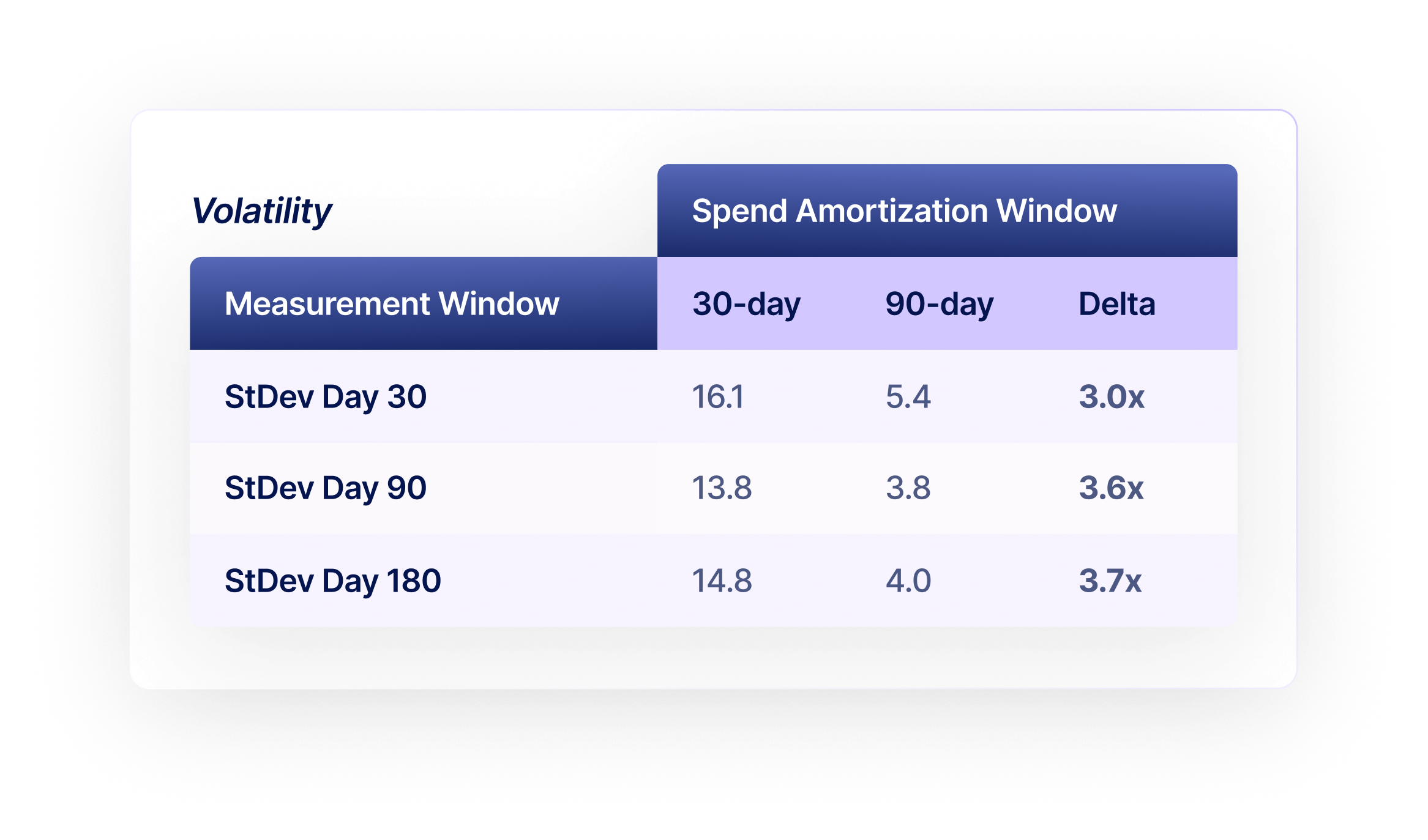
When looking at CPM's Standard Deviation in this integration:
- CPM measured using a 30-day amortization window was 3.0x more volatile at day 30
- Over 180 days, it was 3.7x more volatile than CPM measured with a 90-day window
Higher volatility means noisier signals, wider confidence intervals, and more reactive decisions - exactly when teams are deciding whether to scale or stop.
Importantly, this difference has nothing to do with waiting longer to measure performance. Both teams are looking at results after the same 30 days.
The difference is that a 90-day amortization window aligns cost recognition with how YouTube actually delivers value, producing early reads that are more stable and more precise - not slower.
This is why 30-day amortization doesn’t merely add noise.
It systematically pushes teams toward the wrong conclusions.
The real cost of getting this wrong
An integration that ultimately delivers a $9 CPM after 180 days since the go-live date looks like a $58 CPM failure after 30 days. The signal is wrong, and so are the decisions that follow:
- Winning campaigns get cancelled early. A $58 CPM at day 30 looks like a miss. In reality, the integration is compounding toward one of the most efficient channels in the mix.
- Budget shifts to channels with immediate feedback. When YouTube looks expensive early, teams shift spend to paid social. These channels deliver immediate feedback but no long tail.
- Momentum is never built. YouTube creator performance improves with consistency. Constantly starting and stopping resets trust, resets learning, and prevents those gains from ever materializing.
This isn’t a measurement nuance.
It’s a systematic bias that pushes teams away from one of the highest-ROI channels.
What to do instead
Three practical fixes:
- Adopt a 90-day amortization window: Across large-scale analysis, 90 days captures the accurate economic value of your integrations and prevents killing winners too early
- Wait ~30 days before assessing performance: early signals can be misleading, you should evaluate performance of your video after roughly 30 days to be able to assess performance with confidence
- Monitor trends over time, not snapshots: CPM and other key metrics will continue to decline as views accrue. Ongoing monitoring is critical, as performance can change materially if a video gains algorithmic lift or renewed discovery
How Agentio helps
Agentio automatically prices YouTube integrations based on expected views delivered in the first 30 days.
Once videos are live, Agentio dynamically amortizes spend for each integration over 90 days based on historical data for each individual channel.
Cost-related metrics (CPM, CPC, CAC) are adjusted according to the ratio of views to the projected total views at the 90-day mark. This way, brands see accurate ROI from day one.
If you're a brand looking to tap into the highest performing channel in creator marketing, book a call with our team.
If you're a creator who wants seamless access to the most exciting brand partnerships, join our waitlist.

.png)