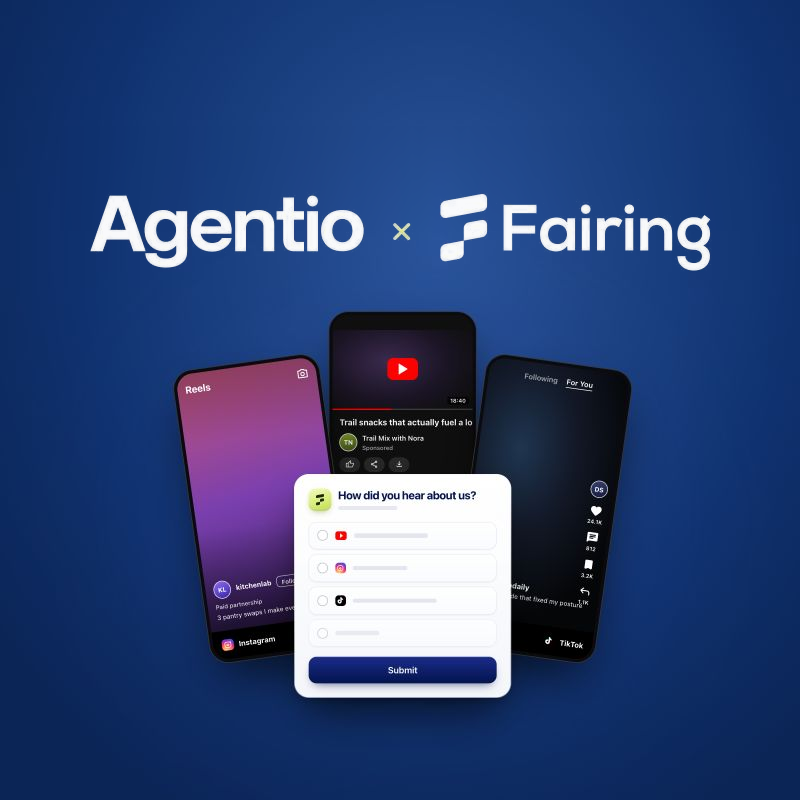

Agentio x Fairing: creator attribution verified at checkout
Creators drive purchases pixels never see. A viewer watches a YouTube integration, remembers the brand, and buys three days later from a Google search. Last-touch attribution hands the order to search. The creator who earned the sale gets no credit, and the brand cuts the creator at renewal.
Our new integration with Fairing fixes this. Your active Agentio creator roster automatically syncs into Fairing's post-purchase survey as named answer options. Survey responses sync back into Agentio with verified order IDs, deduplicated against pixel-tracked sales. You see pixel revenue and survey revenue for every creator in one place, and you renew on total revenue.
1. Pixels miss most creator-driven purchases
Less than 2% of digital ad spend has moved to creators: around $10 billion out of an $800 billion paid media market. Performance brands believe in creator marketing. What they lack is proof of return.
The problem is structural. Platform pixels depend on an immediate click. Creator media rarely works like that. Someone watching a YouTube or Instagram integration does not pause the video to tap a sponsored link. They watch, remember, and buy days later through a direct visit or a branded search.
Pixels only record the click-throughs, so the entire view-through audience stays invisible. Last-touch channels get the credit, and you end up blind to your real creator ROAS. We covered this in depth in our guide to measuring YouTube creator advertising: across 50 Agentio brands, MMM-measured performance came in 1.2x to 5x higher than traditional attribution reported.
2. Static survey lists bury creator orders in an "Influencer" bucket
Post-purchase surveys were built to catch the orders pixels miss. For creator campaigns, they have fallen short for one reason: the answer list is maintained by hand. Every time a campaign launches or a roster changes, someone on the marketing team has to update the list. Nobody does, so the list goes stale.
The shopper who wants to say "I saw this on a creator's video" finds no creator name to pick. They choose "Influencer" and the response lands in a generic bucket no one acts on. You learn creators drove orders. You never learn which ones.
3. How the Agentio x Fairing integration works
Historically, tracking creator campaigns through post-purchase surveys required marketing teams to update talent lists by hand. When campaigns launched, or creator rosters shifted, static lists went stale. This forced customer answers into generic, un-actionable “Influencer” response buckets. Our partnership fixes this with a native two-way integration that connects Agentio’s campaign execution directly to Fairing’s zero-party post-purchase data, replacing spreadsheet maintenance with automated creator attribution verified at checkout.
Once you connect your accounts, the creators currently running across your campaigns automatically become the answer options your customers see. When a shopper indicates a creator sent them, they select that creator by name from a list that reflects your active roster. Fairing then routes those named responses back into Agentio alongside verified order IDs, deduplicated against pixel-tracked sales. Instead of evaluating creators on partial pixel data or vague channel buckets, your renewal conversations happen with both signals side by side.

4. What brands see when both signals are combined
The effect of pairing both signals shows up immediately. Across brands running the integration, up to 73% of survey-attributed creator orders were net-new conversions tracking pixels missed entirely. Those orders existed before. Nobody could see them. The number lines up with what we found in our own measurement guide: 73% of post-purchase survey responses represent net new orders invisible to last-touch and pixel attribution.
The cost of flying blind is real. In portfolio evaluations of YouTube rosters, single-signal pixel tracking would have led brands to cut up to 4 of their top 10 performing creators. Those are the creators driving the most revenue, dropped because their audience buys through search instead of a link.
With both signals combined, every "Influencer" response resolves to a creator by name. Renewal decisions run on total revenue instead of the slice a pixel happened to catch.